

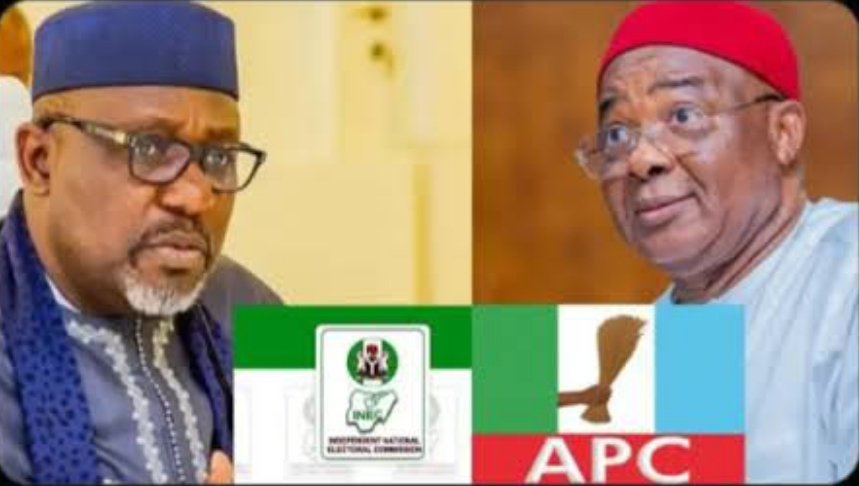
Uzodimma, Okorocha wrestles in Court over senatorial ambition
A fresh battle is brewing between former imp State Governor, Rochas Okorocha, and his successor, Governor Hope Uzodimma, over the All Progressives Congress, APC, senatorial ticket for imp West ahead of the 2027 general elections.
The latest confrontation, which threatens to deepen the longstanding political rivalry between the two men, has moved to the Federal High Court, Abuja, where Okorocha is challenging Uzodimma’s emergence as the APC candidate for the senatorial district.
Okorocha, who represented imp West in the Senate between 2019 and 2023, is asking the court to set aside the Independent National Electoral Commission’s, INEC, publication of Uzodimma’s name and recognise him as the party’s duly nominated candidate.
The suit, marked FHC/ABJ/CS/1854/2026, was filed on August 13, 2026, by Okorocha’s counsel, O.J. Aboje, against Uzodimma, the APC and INEC.
But beyond the battle over the party ticket, the suit has opened a fresh constitutional debate over the propriety of a sitting governor contesting a senatorial election when his tenure would still be running at the time the new Senate is inaugurated in 2027.
Section 183 provides that: “The Governor shall not, during the period when he holds office, hold any other executive office or paid employment in any capacity whatsoever.”
Uzodimma was sworn in for his second term on January 15, 2024, and his tenure is expected to end on January 15, 2028. The 2027 senatorial election, however, will take place before the expiration of his tenure, while the 11th Senate is expected to be inaugurated in June 2027.
The scenario therefore raises the question of what happens if Uzodimma wins the senatorial election and the Senate is inaugurated before his tenure as governor expires.
‘Very complex, novel constitutional issue’
A Senior Advocate of Nigeria, SAN, and constitutional lawyer, Dr. Monday Ubani, said the issue required careful consideration, particularly whether Uzodimma would cease to be governor before assuming the Senate seat.
Ubani noted that resignation is one of the constitutionally recognised ways by which a governor can cease to hold office.
“The Constitution allows a certain ground upon which you can cease to be a governor and one of them is resignation.
“So, if he resigns under the law, has he not fulfilled the constitutional requirement?” he asked.
The lawyer, however, said there were several preliminary questions the court would have to resolve before determining the substantive constitutional issue.
“Though I have not read the suit and its process, the first question I would want to ask is, is it coming as a pre-election issue?
“If it’s coming as a pre-election issue, is it coming under the Electoral Act or is it coming under the provisions of the Constitution? These are issues, first and foremost.
“Then, if it’s coming under any of these things, he (Okorocha) has to satisfy the requirement of locus, his locus standi.
What is his interest?
“And then even if his interest is that of the general interest, what has he suffered personally?
“Because the current jurisprudence in public interest litigation is that you must show what you have suffered or what you are threatening to suffer before the court can hear you under public interest.”
Ubani said the court would also have to examine whether the Constitution permits a sitting governor to contest a senatorial election and, if so, whether the candidate has satisfied the requirements for contesting.
“So, if the Constitution allows him even to be a governor and contest for senatorial, the court will look at whether he satisfied the requirement for contest.
“If he satisfied the requirement, then the court now will also look at the locus of the man who has come to court.
“So, the court will have a lot of things to satisfy before issues can be determined.”
Describing the matter as “a very complex constitutional issue” and a novel one, Ubani said it was nevertheless deserving of judicial consideration.
“It’s a novel one and it’s one that is worth pursuing. It’s a very interesting case that I will want the court to look into and make some pronouncement and establish a proper jurisprudence on the issue.”
‘No constitutional crisis’
President of the African Bar Association, AfBA, Hannibal Uwaifo, said there would be no constitutional crisis if Uzodimma wins the senatorial election but resigns as governor before taking his seat in the Senate.
According to him, Uzodimma is entitled to contest the election because his tenure as governor has not ended, but he cannot continue to occupy both offices.
Uwaifo said: “Before his tenure begins, he will have to resign. He cannot be sitting as governor and senator.
“If he is elected, he will have to resign. And if he resigns, it is valid. There is nothing anybody can do about it. So I can’t see any constitutional crisis over the matter.”
He noted that the inauguration of the 11th Senate was expected in June 2027, while Uzodimma’s tenure as governor would run until January 2028.
“He’s qualified to run and, from my opinion, there is no constitutional crisis or constitutional breach there unless he refuses to resign before taking oath of office as a senator,” he said.
Battle over primary result
Apart from the constitutional question, Okorocha is challenging the outcome of the APC primary conducted on May 18, 2026.
The party’s returning officer declared Uzodimma winner with 230,464 votes, against Okorocha’s 1,098 votes.
Okorocha, however, claims in his court papers that he actually won the primary with 150,780 votes, while Uzodimma scored 102,158 votes.
The conflicting figures have, therefore, become central to the legal battle, with Okorocha asking the court to determine the valid outcome of the primary.
Among the reliefs sought by the former governor are an order setting aside INEC’s publication of Uzodimma as the APC candidate for imp West and an order declaring him the duly nominated candidate of the party.
He is also asking the court to restrain Uzodimma from presenting himself, or being presented by the APC, as its candidate for the senatorial election.
Son deposes
to affidavit
The case has also drawn Okorocha’s son, Amen Rochas, into the legal battle.
Amen, who serves as his father’s Personal Assistant on Political Matters, deposed to the affidavit filed in support of the suit.
In the affidavit, Amen said he was familiar with the circumstances surrounding the dispute and presented the former governor’s account of the disputed primary.
He alleged that Okorocha won the May 18 APC primary with 150,780 votes against Uzodimma’s 102,158 votes.
The affidavit also forms part of Okorocha’s challenge to the publication of Uzodimma’s name as the APC candidate.
The court will now have to determine the legal questions arising from Okorocha’s challenge, including the validity of the disputed primary result, the legal basis for INEC’s publication of Uzodimma’s name and the constitutional implications of a sitting governor seeking a Senate seat before the expiration of his tenure.
For imp APC, the case has opened another front in the political contest between Okorocha and Uzodimma, with the outcome potentially determining not only who flies the party’s flag in imp West in 2027, but also how Uzodimma’s political future unfolds after the governorship.
Credit: Vanguard Newspaper

[…] INEC’s publication comes as preparations intensify for the 2027 general elections, with the presidential and National Assembly elections scheduled for January 16, 2027. The commission’s official election calendar also lists the governorship and State House of Assembly elections for February 6, 2027 […]