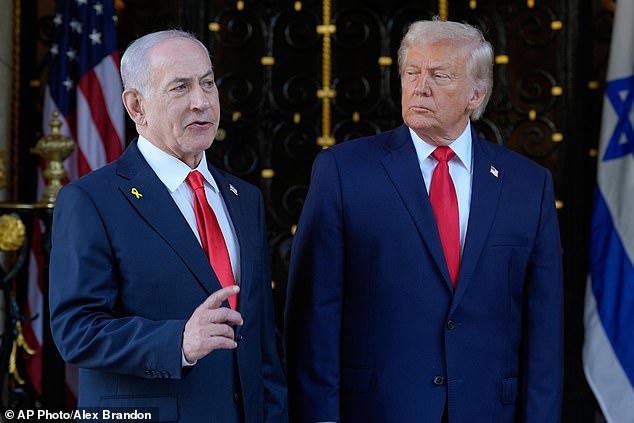
Netanyahu rejects Trump’s plan for Gaza until Hamas is disarmed
Benjamin Netanyahu has rejected Donald Trump’s 15-point plan for Gaza and vowed that the IDF will not withdraw until Hamas is ‘genuinely disarmed’.
Last month, President Trump’s Board of Peace said it had reached an agreement for the ‘complete disarmament’ of Hamas and other armed armed groups in Gaza.
He called it ‘a monumental step toward lasting peace and security’.
However, Hamas said it would only hand over its heavy weapons if Israel ends ‘all forms of aggression’ and withdraws its military from Gaza.
Israel has continued bombing the area despite agreeing to a ceasefire in October.
After more than a week of gradually escalating criticism of the plan, Netanyahu explicitly opposed it in the face of pushback from his right-wing base.
During a cabinet meeting today, Netanyahu said: ‘Israel rejects the 15-point document.’
He added: ‘The Israeli military ‘will not carry out any withdrawal until Hamas is genuinely disarmed and will continue to thwart threats against our forces and our citizens.’
Netanyahu described Trump, with whom he has also had a growing break on Iran, as ‘our greatest friend in the White House’ – but quickly made clear he was willing to challenge him.
He said Israel was raising its objections to the Gaza plan with the United States.
‘They have ideas; some of them are acceptable to us and some are not, and we know how to stand our ground on these matters,’ he said.
Netanyahu, Israel’s longest-serving leader, is running even or trailing in some polls ahead of October 27 elections, the country’s first since the devastating October 7, 2023 attack by Hamas.
Polls show that the Gaza plan is widely unpopular with Netanyahu’s right-wing base and far-right members of his cabinet having urged him to call a new vote to kill the Gaza plan.
Hamas, days after selecting a new leader, Khalil al-Hayya, announced it supported the Gaza plan. It called on the United States to pressure Netanyahu.
‘We expect the mediators and the American guarantor to pressure Netanyahu and his government to adhere to the roadmap and not obstruct the process for internal political and electoral reasons,’ Bassem Naim, a member of Hamas’s political bureau, told AFP.
Netanyahu until recently campaigned on the strength of his relationship with Trump, who since his first term has taken unprecedented steps to back Israel, including moving the US embassy to Jerusalem.
Trump joined Netanyahu in late February in attacking Iran. But the two diverged when Trump sought a ceasefire with Iran in April as the war sapped his popularity at home and sent oil prices soaring.
Netanyahu told his cabinet that ‘with an agreement or without an agreement, as long as I am prime minister, Iran will not have nuclear weapons’, a goal he has long alleged Tehran is pursuing.
Netanyahu last week also ordered fresh strikes on Lebanon in response to what Israel called a ceasefire violation by Iran-backed Hezbollah, just as Israel and Lebanon were holding US-mediated talks.
The Gaza plan was the latest stage in a US-brokered ceasefire announced in October that has reduced but not ended Israeli operations in Gaza.
Trump had described as a ‘major milestone’ the agreement by Hamas to surrender weapons to a nascent Palestinian governing body.
The plan said Israel would begin pulling out forces in tandem with the disarmament, a timeline adamantly rejected by Israel.
After meeting Netanyahu last week, Trump’s body implementing the deal, dubbed the Board of Peace, backtracked and said Israel would only need to withdraw after ‘complete’ disarmament, but it was apparently not enough for the Israeli leader.
Netanyahu said that Hamas must give up all of its weapons.
‘We are talking about real disarmament, not fictitious disarmament,’ Netanyahu said.
It comes in the wake of Trump’s humiliation on Wednesday night when Iran secured a deal with Oman to police the Strait of Hormuz.
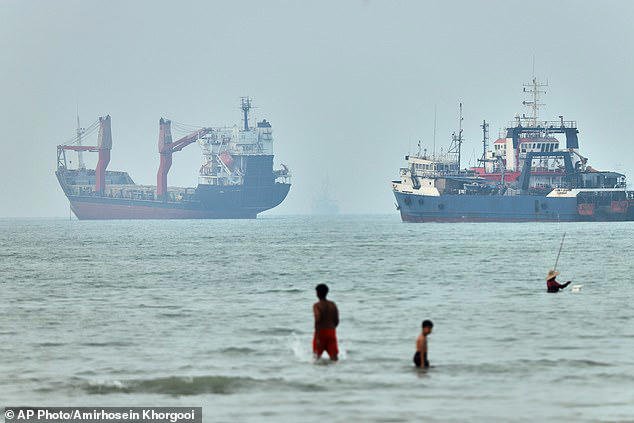
After five months of regional conflict, the prospective deal paves the way for Iran to deny access to Western ships along the key route.
While the proposal excludes tolls or service fees being levied against shipping, such a prospect remains a major fear for oil producers.
The arrangement leaves Donald Trump facing a political backlash at home and abroad as the US finds itself in a weaker position than before the conflict began.
Back in February, the Strait was open to all shipping, with 20 per cent of the world’s oil and liquefied natural gas supplies passing between its banks.
Since then, traffic has ground to a halt as insurers withdrew cover for super-tankers and cargo vessels due to the threat of Iranian attacks.
The long-term framework being finalised last night would give Iran control of inbound shipping while outbound traffic would be jointly managed by Iran and Oman.
Mr Trump is expected to lose support over the Gulf crisis while US allies in the region are alarmed over Iran’s expanding influence over shipping routes.
At the end of July, Trump lashed out at Netanyahu before vowing to destroy Iran’s last nuclear facility, which is buried deep inside a mountain.
The President admonished the Israeli leader for telling reporters that he would present Trump with evidence that Iran is still developing its nuclear program at the site, known as Pickaxe Mountain.
‘Well, I don’t need Bibi to tell me that. Bibi is telling me that because he wants me to stay involved,’ Trump told Fox News ahead of his Oval Office meeting with Netanyahu.
Trump then warned Netanyahu not to air grievances in public and to raise them with him privately instead.
‘I heard Bibi announce that. I said, ‘Why didn’t you just tell it to me? Why do you have to announce it to the world?”
Trump also vowed to destroy the secret facility if Iran did not agree to make a deal to abandon their nuclear program and reopen the Strait of Hormuz.
‘I know exactly what’s going on at Pickaxe. It’s not a big problem. We took out their nuclear site, and we’ll have to take out Pickaxe if we don’t make a deal,’ Trump added.
Pickaxe Mountain, known in Farsi as Kuh-e Kolang Gaz La, is a tunnel complex Iran has been carving into a mountainside near its Natanz enrichment site. It is buried so deep that weapons experts doubt even America’s most powerful bunker-buster could reach it.
Tensions having been building between the US and Israeli leaders in recent months.
In June, it was reported that in a 2025 phone call concerning negotiations over a ceasefire in the Gaza Strip Trump was said to have told Netanyahu that ‘all the Jews are sick’ of him, according to a book by New York Times journalists Maggie Haberman and Jonathan Swan.
The book, ‘Regime Change: Inside the Imperial Presidency of Donald Trump,’ looks at the first year of Trump’s second term in office, during which the US brokered a ceasefire between Israel and Hamas, bringing what was hoped to be the end of the two-year war in Gaza.
Credit: Msn News